


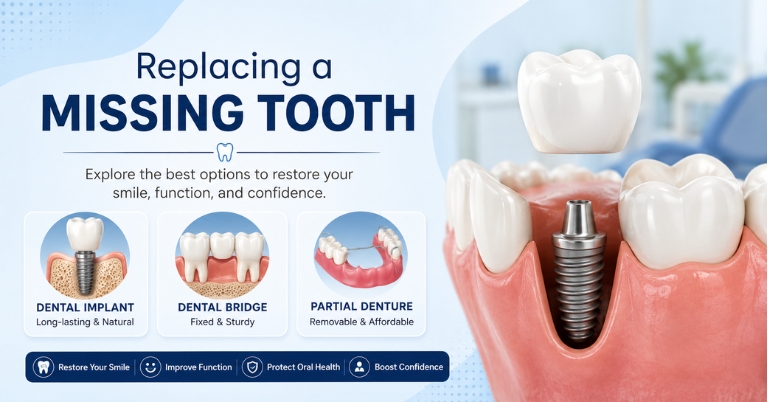
Losing a tooth can affect much more than your smile. Whether it happens because of tooth decay, gum disease, an injury, or another dental problem, leaving the gap untreated can lead to several oral health issues over time.
The good news is that modern dentistry offers safe and effective ways to replace a missing tooth. From dental implants to bridges and partial dentures, each treatment has its own benefits. The right choice depends on your oral health, lifestyle, and long term goals.
At Dr. Charu’s Multispeciality Dental Clinic, we believe every patient deserves to understand their options before making a decision. We take the time to explain each treatment and recommend what is best for your smile.
A missing tooth is not just a cosmetic concern. Every tooth plays an important role in supporting your bite, helping you chew properly, and maintaining the alignment of your other teeth.
When a tooth is lost, the jawbone beneath it gradually begins to shrink because it no longer receives the natural stimulation created while chewing. Over time, the neighboring teeth may shift into the empty space, leading to bite problems, difficulty cleaning between teeth, and an increased risk of gum disease.
Replacing a missing tooth as early as possible helps protect your oral health and prevents more complex dental problems in the future.
Dental implants are widely considered one of the most effective solutions for replacing a missing tooth. Unlike other treatments, an implant replaces both the tooth root and the visible crown.
A small titanium implant is placed into the jawbone, where it gradually bonds with the bone during healing. Once the area has healed, a custom made dental crown is attached to complete the restoration.
Dental implants require a minor surgical procedure and the treatment takes several months because the implant needs time to heal before the final crown is placed. For many patients, the long lasting results make it a worthwhile investment in their oral health.
A dental bridge replaces a missing tooth by using the healthy teeth on either side of the gap for support. These teeth are prepared and covered with crowns that hold an artificial tooth securely in place.
A bridge provides a fixed solution that restores both appearance and function without surgery.
A bridge requires reshaping the supporting teeth, even if they are healthy. Since it does not replace the tooth root, the jawbone beneath the missing tooth may gradually shrink over time.
A removable partial denture is designed to replace one or more missing teeth using an appliance that rests on the gums and is supported by the remaining natural teeth.
It is commonly recommended for patients missing several teeth or for those who are not suitable candidates for implant treatment.
It may take some time to become comfortable wearing a removable denture. Since it does not replace the natural tooth root, it cannot prevent jawbone shrinkage.
| Feature | Dental Implant | Dental Bridge | Partial Denture |
|---|---|---|---|
| Fixed in the mouth | Yes | Yes | No |
| Surgery required | Yes | No | No |
| Uses neighboring teeth for support | No | Yes | Minimal |
| Helps preserve jawbone | Yes | No | No |
| Looks natural | Excellent | Very Good | Good |
| Suitable for multiple missing teeth | Sometimes | Yes | Yes |
Choosing the best way to replace a missing tooth depends on several factors.
Your dentist will consider:
A thorough examination and digital imaging help determine which treatment will provide the best outcome for your smile.
Yes. Leaving a missing tooth untreated can cause neighboring teeth to shift, affect your bite, make chewing more difficult, and lead to gradual jawbone loss.
Dental implants are the closest replacement to a natural tooth because they replace both the root and the crown.
In many cases, yes. Your dentist will evaluate the amount of available jawbone and recommend the most suitable treatment for your situation.
Treatment time depends on the option you choose. Dental bridges and partial dentures are usually completed sooner, while dental implants require additional healing time before the final crown is placed.
Yes. Replacing a missing tooth restores your smile, improves chewing, supports clear speech, and helps maintain your facial appearance.
Every patient has different needs, which is why there is no single treatment that is right for everyone. The best solution depends on your oral health, your goals, and the condition of your teeth and jawbone.
At Dr. Charu’s Multispeciality Dental Clinic, we explain every option clearly and help you choose the treatment that offers the best long term results for your smile.
If you are thinking about replacing a missing tooth, schedule a consultation with our experienced dental team. We are here to help you smile, eat, and speak with confidence again.
Copyright © 2026. All Rights Reserved



Leave a Reply