


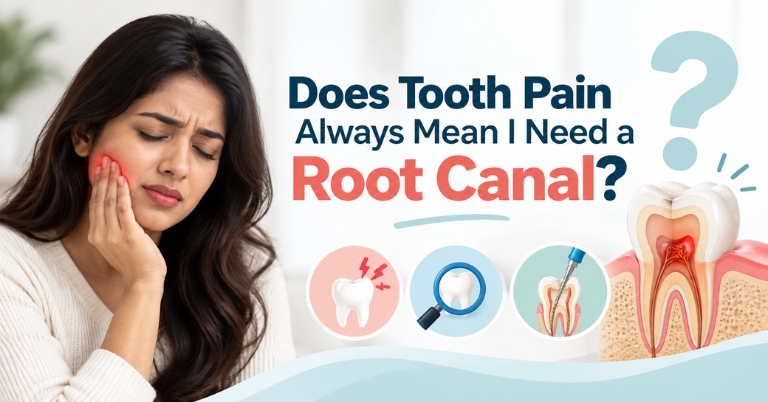
Tooth pain can be worrying, especially when the first thing that comes to mind is, “Do I need a root canal?” The good news is that tooth pain does not always mean you need root canal treatment.
Toothache can happen for several reasons, including tooth decay, tooth sensitivity, a cracked tooth, a loose or damaged filling, gum problems, teeth grinding, or inflammation or infection of the dental pulp. A root canal may be necessary when the pulp inside the tooth has become seriously inflamed or infected, but pain alone is not enough to make that diagnosis.
As a dentist, I always recommend identifying the actual cause of the pain before deciding on treatment. The goal should be to treat the problem while preserving as much healthy natural tooth structure as possible.
No. Tooth pain does not automatically mean you need a root canal.
A root canal is generally considered when the soft tissue inside the tooth, called the pulp, is irreversibly inflamed, infected, or no longer healthy enough to recover. However, some types of tooth pain can be treated with a filling, treatment for sensitivity, correction of a faulty restoration, management of a cracked tooth, gum treatment, or other appropriate dental care.
This is why I would not advise anyone to decide on root canal treatment based only on the intensity of pain.
The tooth contains an inner area called the pulp. It contains nerves and blood vessels. When the tooth is affected by decay, trauma, cracks, or other damage, the pulp can become irritated or inflamed.
But not every irritated tooth needs a root canal.
For example, brief sensitivity to cold or sweet foods that disappears quickly can sometimes be associated with minor decay, exposed tooth surfaces, gum recession, or a loose filling. In some situations, treating the underlying cause can resolve the problem without root canal treatment.
On the other hand, pain that continues after hot or cold stimulation has been removed, spontaneous toothache, severe pain, or swelling can be more concerning and should be professionally evaluated.
There are certain symptoms that make us more suspicious of significant pulp damage.
One of the symptoms I pay close attention to is pain that continues after the hot or cold stimulus is removed. The American Association of Endodontists notes that lingering thermal pain, often lasting 30 seconds or longer, can be associated with irreversible pulp damage.
This does not mean you should diagnose yourself with irreversible pulpitis. It means the symptom deserves a proper dental examination.
If a tooth starts hurting on its own without eating or drinking anything, particularly if the pain is severe or affects sleep, the pulp may be significantly inflamed.
A persistent or worsening toothache should not simply be ignored because the pain may temporarily reduce later. Some dental conditions can progress even when the symptoms change.
Pain when you bite can occur with deep decay, a cracked tooth, a loose filling, or problems involving the pulp or tissues around the tooth. So even this symptom does not automatically mean a root canal is required.
The important question is why the tooth hurts when you bite.
Swelling around a painful tooth can indicate an infection or an abscess. This requires prompt dental assessment because dental infections need appropriate treatment rather than simply waiting for the pain to disappear.
A deep cavity, significant crack, trauma, or previous dental treatment can affect the pulp. In some cases, root canal treatment may be needed to save the tooth.
This is one of the most common questions I hear from patients.
A quick, sharp sensation when you have ice cream or a cold drink does not automatically mean the nerve is permanently damaged.
Sensitivity can be related to exposed dentine, gum recession, minor decay, or other factors. The treatment depends on the underlying cause.
Not every cavity needs a root canal. If decay has not caused irreversible damage to the pulp, restoring the tooth may be sufficient.
The earlier a cavity is treated, the more likely it is that simpler treatment can be considered.
Sometimes a tooth becomes sensitive or painful because an existing restoration is damaged or no longer sealing the tooth properly. In such cases, your dentist may determine that repairing or replacing the restoration is appropriate.
A cracked tooth can cause sharp pain when biting. The treatment depends on the location and severity of the crack, whether the pulp is involved, and whether the tooth can be predictably restored.
Grinding or clenching can cause a dull ache or pressure in the teeth and jaw. The American Association of Endodontists also notes that bruxism and sinus-related pain can sometimes feel like tooth pain.
This is another reason why identifying the source of pain is so important.
A proper diagnosis usually involves more than simply asking where the tooth hurts.
During an examination, I may consider:
The American Association of Endodontists explains that pulp diagnosis should consider the patient’s pain history together with appropriate clinical testing.
This is important because pain can sometimes be difficult to localise. A patient may feel pain in one area even though the actual source is a different tooth or another condition entirely.
Yes.
This is something patients often misunderstand.
A reduction in pain does not necessarily mean the underlying dental problem has healed. In some situations involving pulp damage or infection, symptoms can change over time.
That is why I do not recommend waiting simply because the pain has suddenly disappeared, especially when there has been severe pain, swelling, a deep cavity, trauma, or a previously damaged tooth.
The earlier the cause is identified, the more treatment options may be available.
No.
Although severe toothache is a common reason patients seek treatment, a tooth that requires root canal treatment may not always produce dramatic pain. Some teeth can have significant pulp or surrounding tissue problems with limited or even no obvious symptoms.
A clinical examination and appropriate testing are therefore more reliable than pain severity alone.
When root canal treatment is indicated, the purpose is to remove damaged or infected pulp, clean and disinfect the root canal system, and then fill and seal the tooth. The aim is to control the infection and preserve the natural tooth where possible.
Modern dental techniques and effective local anaesthesia have also improved patient comfort during root canal procedures.
At our clinic in Coimbatore, I believe patients should understand why a treatment is recommended before beginning it. Detailed diagnosis and treatment planning are an important part of responsible dental care.
Do not ignore persistent tooth pain.
You should arrange a dental examination particularly when you have:
The NHS advises seeing a dentist when toothache lasts more than two days, does not improve with painkillers, or occurs with symptoms such as fever, pain on biting, red gums, bad taste, or facial or jaw swelling.
Severe swelling can sometimes become a medical emergency.
Seek urgent medical attention if swelling around the mouth, eye, or neck develops or if swelling makes it difficult to breathe, swallow, or speak.
Do not delay care in these situations.
Painkillers may provide temporary relief, but they do not remove the underlying dental cause.
Antibiotics are also not a substitute for appropriate dental treatment in most cases of pulpal or periapical dental pain. The American Dental Association recommends prioritising appropriate dental treatment for many of these conditions, with antibiotics generally reserved for situations involving systemic involvement such as fever or malaise, according to the clinical circumstances.
Always use medicines according to professional medical advice and your individual health circumstances.
Does tooth pain always mean you need a root canal? No.
Tooth pain is a symptom, not a diagnosis.
You may have a cavity, sensitivity, a damaged filling, a cracked tooth, gum-related problem, grinding-related pain, sinus-related pain, or inflammation or infection affecting the pulp. Some of these conditions can be managed without root canal treatment, while others may require treatment to save the tooth.
The safest approach is to have the tooth examined rather than assuming that every toothache needs a root canal.
At Charu’s Multispeciality Dental Clinic in Coimbatore, I focus on detailed diagnosis and personalised treatment planning so that patients understand the cause of their dental problem and the available treatment options. My practice includes root canal treatment, restorative dentistry, dental implants, orthodontics, gum care, preventive dentistry, and other dental services for children and adults.
If you are experiencing persistent tooth pain, schedule a dental consultation and get the cause properly diagnosed.
No. A cavity only requires root canal treatment when the decay has caused significant and irreversible damage to the pulp. Earlier-stage decay may often be treated with a restoration.
Not necessarily. Brief cold sensitivity can have several causes, including exposed dentine, gum recession, minor decay, or a restoration problem. Lingering sensitivity is more concerning and should be evaluated.
No. Severe pain can occur with several dental conditions. A dentist needs to determine the actual source and cause of the pain before recommending root canal treatment.
It is better not to assume that the problem has healed simply because the pain has stopped. Some dental conditions can change over time without resolving the underlying cause.
Yes, a crack can affect the pulp and may require root canal treatment in some cases. However, not every cracked tooth needs a root canal. The treatment depends on the extent and location of the crack and whether the tooth can be restored.
With modern local anaesthesia and appropriate pain-control techniques, root canal treatment is generally performed with the goal of keeping the patient comfortable. Some soreness or sensitivity can occur after treatment and usually settles as the tooth heals.
Copyright © 2026. All Rights Reserved




Leave a Reply