


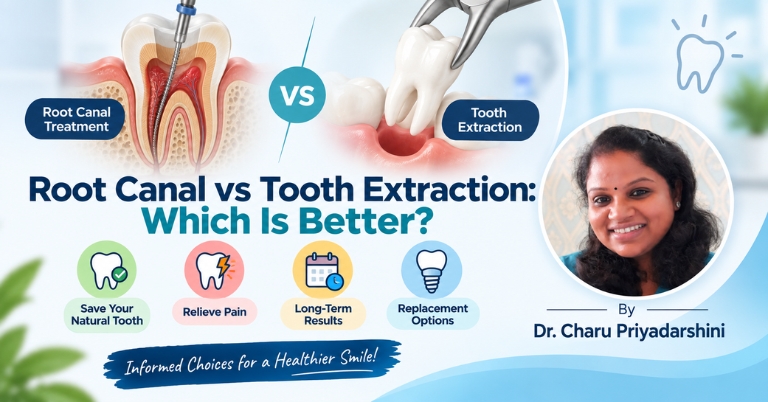
When a tooth becomes badly decayed, infected, or damaged, many patients face the same question: “Should I save the tooth with a root canal or have it removed?”
The answer depends on the condition of your tooth, but in most cases, saving your natural tooth is preferable when it can be restored successfully. Let’s understand the difference between root canal treatment and tooth extraction.
A root canal is a treatment used when the inside of the tooth, called the pulp, becomes infected or inflamed. This can happen because of deep decay, cracks, repeated dental procedures, or an injury.
During a root canal, the dentist removes the infected pulp, cleans and disinfects the inside of the tooth, and seals it. A crown may then be recommended to protect the tooth, especially if it has lost significant strength.
The biggest advantage is simple: your natural tooth stays in your mouth.
Tooth extraction means completely removing a tooth from its socket. It may be recommended when a tooth is too damaged or weakened to be predictably restored.
For example, extraction may be considered when there is extensive decay, a severe crack extending below the gum line, advanced bone loss, or insufficient healthy tooth structure remaining.
However, removing a tooth does not always mean the treatment journey is over. The missing tooth may eventually need replacement with a dental implant, bridge, or denture to restore chewing function and prevent unwanted movement of nearby teeth.
If your dentist believes the tooth can be successfully treated and restored, root canal treatment is generally the preferred option because it preserves your natural tooth.
Keeping your natural tooth can help maintain normal biting and chewing and avoids immediately creating a gap that may require replacement.
Extraction, on the other hand, can sometimes be the better choice when the tooth cannot be predictably saved. Trying to preserve a tooth that has very little healthy structure or a severe fracture may not provide a long-term solution.
One of the biggest fears patients have is pain. Modern root canal treatment is performed under local anaesthesia, so you should not feel the procedure itself in the way many people imagine.
Some tenderness or discomfort can occur for a few days afterward, particularly if the tooth was already infected. Your dentist can advise you on appropriate aftercare.
There is no one-size-fits-all answer to root canal vs extraction. Your dentist will assess the tooth, surrounding bone and gums, infection, cracks, and the amount of healthy tooth structure remaining before recommending treatment.
If the tooth can be predictably saved, preserving your natural tooth is usually worth considering. If it cannot be restored, extraction followed by an appropriate tooth-replacement option may be necessary.
If you have persistent tooth pain, swelling, sensitivity, or a badly damaged tooth, don’t wait for the problem to become worse. An early dental examination can help determine whether your tooth can still be saved.
Copyright © 2026. All Rights Reserved




Leave a Reply